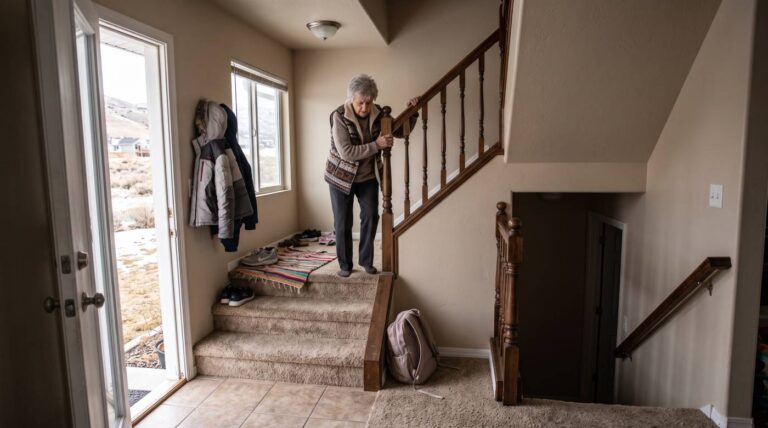
Almost every question about stair lifts — what it costs, how long it takes, which models are even on the table — is downstream of one thing. Straight rail, or curved rail.
You do not need anyone to visit to work out which one you have. Go and stand at the bottom of your stairs.
The test
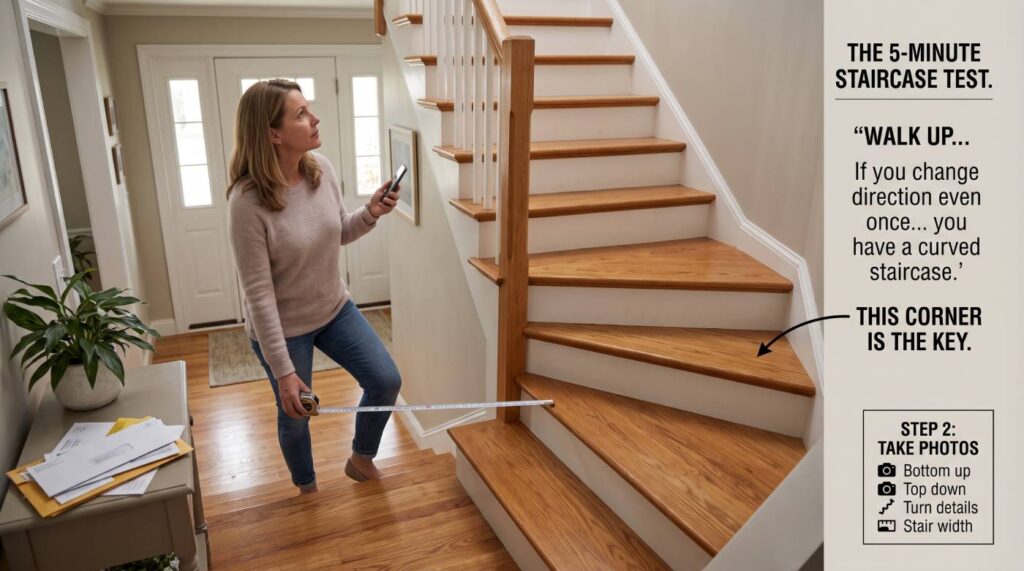
Walk up. If you can go from the bottom step to the top step without ever changing direction, you have a straight staircase.
If you change direction even once — a quarter turn, a half turn, a landing you pivot on, three wedge-shaped steps at the bottom — you have a curved staircase.
That is the whole test. The rail has to follow the stairs, so any turn in the stairs is a turn in the rail.
Why people get it wrong
Two things fool people.
Winder steps. Those wedge-shaped triangular treads that turn a corner without a flat landing. They look like part of a normal flight. They are a turn, and they need a curved rail.
The flared bottom step. Some staircases have one wider step at the bottom that curves out slightly into the hall. That is usually still a straight run for rail purposes, but it is exactly the kind of thing that separates a firm quote from a revised one. Photograph it and let someone look.
What each one means for you
If it is straight
Good news, and you can more or less relax about the whole project. Straight rails are stock parts cut to length. The lift is cheaper, and installation is usually a matter of hours rather than weeks.
The two straight models we fit are the Nautilus Premium and, where more capacity is needed, the Nautilus Heavy Duty.
If it curves
The rail has to be manufactured for your staircase specifically. Somebody measures it, a factory builds a one-off rail, and it comes back weeks rather than days later.
That is why curved quotes are higher, and it is also why nobody can give you a real curved price over the phone. Anyone who does is guessing.
For curved runs we fit the Flow X Curved and the Harmar CSL500 Helix.
The trade-off nobody volunteers
If your staircase has a proper flat landing in the middle — big enough to stand on and turn around comfortably — you may have a choice.
One curved lift that carries you the whole way, or two straight lifts with a transfer on the landing.
Two straight lifts are usually cheaper. But it means standing up, walking across the landing and sitting down again, every single trip. For somebody with balance problems, that transfer is the most dangerous moment of the journey, and the saving is not worth it. For somebody steady on the flat who simply cannot manage a long flight, it can be a sensible answer.
It depends entirely on the person, which is why it should be discussed rather than quoted.
While you are standing there, check three more things
- Which side? Most lifts fit either side. Look at where the rail would park at the top and bottom, and whether it would block a doorway.
- Stair width. Measure the narrowest point, wall to wall or wall to banister. Anyone still needs to walk past the parked lift.
- What is at the bottom? A front door, a hallway, a turn into a room. If the rail would end anywhere near a doorway you use, ask about a folding rail — stepping over a rail at the bottom of the stairs is the exact hazard you are trying to remove.
What to send an installer before they visit
Five photos will save everyone a trip:
- From the bottom, looking up the full flight
- From the top, looking down
- Each turn or landing, straight on
- The bottom of the stairs including whatever is behind you
- A tape measure across the narrowest point of the stairs
With those, most companies can tell you straight or curved, roughly what it will cost, and whether there is anything unusual about your staircase — before anyone knocks on the door.
Not sure what you are looking at? Send the photos or book a free in-home assessment and we will tell you what your staircase needs. If it is straight, we will say so, and it will cost you less.