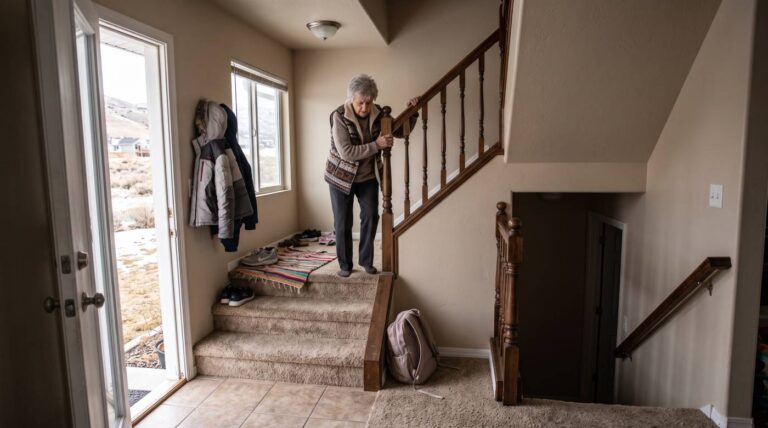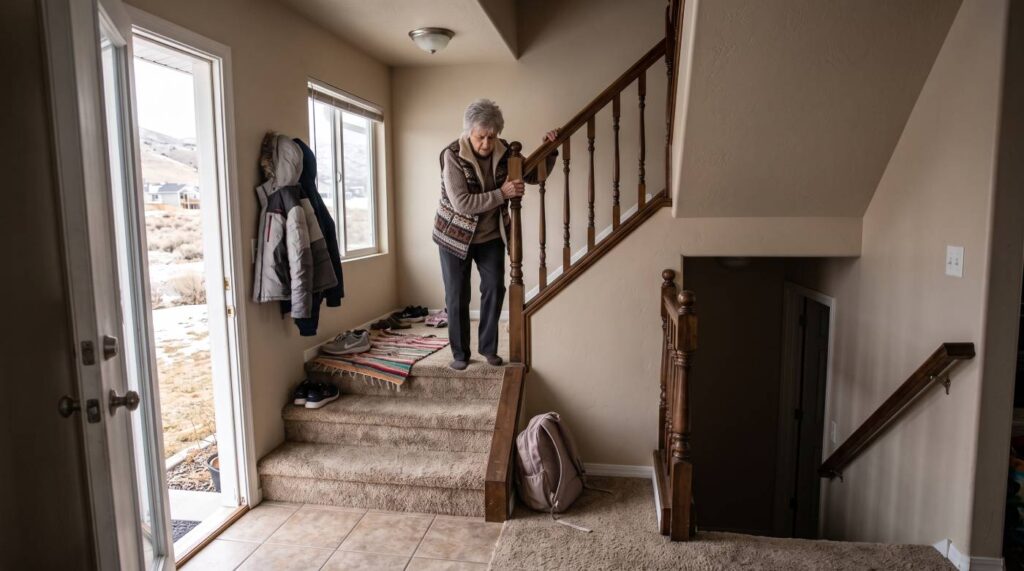
Drive through almost any Wasatch Front neighborhood built between the sixties and the eighties and you will see the same house repeatedly. Front door in the middle, half a flight up to the living room, half a flight down to the family room. Split-entry, split-level, tri-level, whatever the listing calls it.
It is one of the most common house types in Salt Lake and Utah County. It is also, in our experience, the most consistently underestimated staircase in the state.
Not because the flights are long. Because they are short.
The short-flight problem
Ask anybody which is more dangerous — a fourteen-step staircase or a seven-step one — and they will say the fourteen. It is twice the distance.
That is not how it works in practice, for three reasons.
Nobody respects a short flight
People hold the rail on a long staircase. On six or seven steps they do not. They carry the laundry basket with both arms, take the steps quickly because it is barely a staircase, and look at the room ahead rather than the treads.
Every habit that keeps someone safe on a full flight gets abandoned on a short one.
It is not the height that hurts you
Falls do not injure people in proportion to distance. They injure people according to how they land and what they land on.
A split-entry flight typically ends on tile or laminate at the front door. A fall onto that surface from seven steps does not do meaningfully less damage than a fall from fourteen onto carpet. The CDC counts roughly three million emergency department visits a year from older-adult falls, and about 319,000 hospital admissions for hip fractures.
You use them more than any other stairs in the house
This is the part that is specific to this house type. In a conventional two-story home the stairs connect the bedrooms to everything else — a handful of trips a day.
In a split-entry, the stairs are the entrance. Every trip to the car, every bag of groceries, every visitor, every trip to the laundry passes through them. Frequency does more to determine risk than any single feature of a staircase.
The handrail nobody checks
Two things we see constantly in this house type, and both are cheap to fix even if you never buy a lift.
One rail, wrong side. Split-entry flights are frequently open on one side with a rail only on the wall side. Whether that is the useful side depends entirely on which hand the person has strength in.
The rail that stops early. A handrail that ends at the last riser instead of continuing past the bottom step is the single most common design fault we find. People let go a step early, which is precisely where they need it.
Go and put your hand on the rail at the top of your stairs, walk down normally, and notice where you have to let go. If that is before both feet are on the flat, that is worth a carpenter's afternoon.
What this means if you are looking at a lift
Split-entries create a specific problem. The two flights meet at the entry landing, which is usually small, and which is where the front door is.
The obvious suggestion — two straight lifts, one up and one down, transfer on the landing — is cheaper and is often the wrong answer here.
Ask yourself where that transfer happens. On a compact landing, next to a door that opens inward, while carrying whatever you came in with. That is a worse place to be standing up and sitting down than a wide mid-flight landing in a conventional home.
Sometimes two straight lifts genuinely is right. But it should be a decision made standing in that entryway, looking at the door swing and the landing depth — not one made from a floor plan or a phone call.
And if the flights turn at all — winders down to the family room are very common in tri-levels — you are looking at a curved rail regardless.
If you only do one thing
Walk your own stairs tonight, both flights, and answer three questions:
- Is there a rail on the side you would actually reach for, and does it continue past the bottom step?
- What is the floor at the bottom of each flight, and is anything stored on the landing?
- Has anyone in the house changed how they use these stairs — going up less, carrying things differently, taking them one at a time?
The third question is the important one. Less than half of older adults who fall mention it to their doctor, and fewer still mention it to their children. A change in how someone uses the stairs shows up long before anyone admits to a stumble.
We have been fitting lifts on Wasatch Front staircases since 1991, and split-entries are a house type we know well. If you live in one and you are not sure what it needs, book a free in-home assessment — we will walk both flights with you and tell you honestly whether you need one lift, two, or a better handrail and nothing else.